
Our Mission
The real climate
impact of aviation
Making aviation's hidden climate impact visible and actionable.
Aviation's total climate impact goes beyond CO₂. Non-CO₂ effects like contrails contribute the majority of aviation's warming.
vs CO₂ alone
~35%
of aviation's total warming from contrails
~65%
from CO₂ emissions
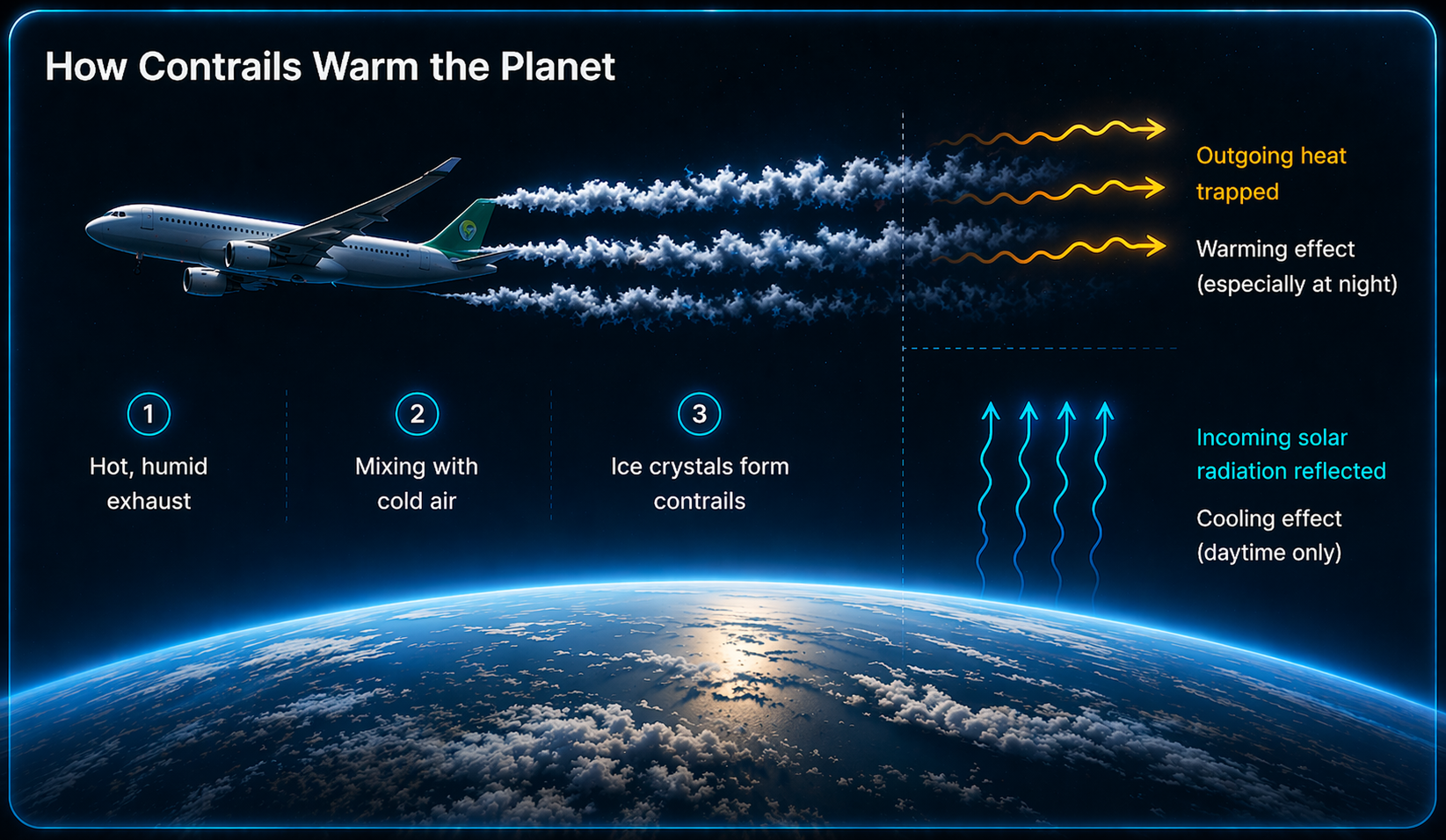
How Contrails Warm the Planet
A hidden multiplier
The Invisible Problem
When you book a flight, you might see a carbon offset option. But CO₂ is only part of the story.
Condensation trails — contrails — form when hot, humid engine exhaust meets cold air at cruise altitude. In the right atmospheric conditions, these thin ice-crystal clouds persist for hours, trapping outgoing heat radiation like a blanket.
Research from institutions including MIT, DLR, and Imperial College London estimates that contrails cause approximately 35%of aviation's total climate warming effect. For some flights, the contrail impact alone can be 2–4x greater than the CO₂ emitted.
See the Science Behind ItRadiative Forcing
Solar vs. thermal radiation
Contrails interact with both incoming solar radiation (cooling effect during daytime) and outgoing thermal radiation (warming effect at all times). At night, the net effect is almost always warming.
SkyPrint calculates the energy forcing in Watts per square meter (W/m²) for each flight segment.
The Science
Schmidt-Appleman Criterion (SAC)
Contrails form when the mixing of hot exhaust with ambient air passes through liquid water saturation. The SAC predicts whether this threshold is crossed based on temperature, pressure, and humidity at cruise altitude. If the surrounding air is also ice-supersaturated, the contrail persists.
Inputs
Temperature Pressure Humidity
Predicts
Contrail Formation
Outcome
Persistent Contrail
The Science
CoCiP (Contrail Cirrus Prediction)
Developed by DLR and extended by Breakthrough Energy, CoCiP models the full lifecycle of a contrail — formation, spreading, and dissipation — computing the net energy forcing (warming or cooling) over its lifetime. SkyPrint uses CoCiP via the open-source PyContrails library.
Models
Lifecycle
Computes
Energy Forcing (W/m²)
Outputs
Net Warming or Cooling
What You Can Do
Most contrail warming comes from a small fraction of flights flying through ice-supersaturated air. Modest altitude changes (1,000–2,000 ft) can avoid these regions with minimal fuel penalty — typically under 2% additional fuel burn.
Contrail-aware flight planning represents one of the most cost-effective climate interventions available to aviation today.
Small Changes, Big Difference
Altitude or timing adjustments can avoid high-risk conditions.
See How It WorksSupport a Smarter Aviation Future
Contrail-aware planning is one of the biggest opportunities to reduce aviation's warming.
Explore Solutions